The Forgotten Principle
Fraternity as a political category, and a network that has taken it seriously. Notes after the VIII International Seminar of RUEF in Santiago de Chile.
This week I was in Santiago for the eighth international seminar of RUEF, the Red Universitaria para el Estudio de la Fraternidad, hosted by the Pontificia Universidad Católica de Chile. Its theme was the challenges of fraternity in times of polarization.
Polarization as a pathology of relations
Polarization is usually described in terms of opinions: views move further apart and disagreement gets harder. That is true, but it may miss something. What polarization breaks is not agreement but recognition. Two groups can disagree strongly and still see each other as part of the same community. Under polarization this stops: the other side is no longer someone to talk to but a threat, and disagreement turns into hostility.
Seen in this way, polarization is a pathology of relations rather than of rights. Citizens on both sides may enjoy the same freedoms and the same formal equality, and still no longer see one another as part of a common body. This is the point at which the categories we normally use to think about democracy begin to show their limits.
Baggio and the forgotten principle
The clearest diagnosis of these limits that I know is due to Antonio Maria Baggio, who was a professor of political philosophy at the Istituto Universitario Sophia. In Il principio dimenticato (The Forgotten Principle, 2007), Baggio starts from the revolutionary triad of liberty, equality and fraternity, and observes an asymmetry. Liberty and equality became political principles in the full sense. They were translated into constitutions, legal systems and public institutions, and each was developed by a great tradition of political thought. Fraternity received no comparable translation. It was left to private life, to religion, or to rhetoric. Of the three terms, it is the one that was forgotten. Some in the network prefer to call it a contested rather than a forgotten principle (Barreneche 2012), but the diagnosis is the same.
Baggio’s thesis is stronger than the claim that a third value deserves more attention. Fraternity, on his account, is what holds the other two together. Liberty without fraternity tends to degenerate into privilege; equality without fraternity tends to become an imposed uniformity; and the two, left to themselves, end up being played against each other. Fraternity is the regulative principle that makes them compatible. It does so because it combines two features that neither of the other principles contains on its own: parity, in the sense that no one stands above the other, and the recognition of difference, in the sense that the other is not required to become like me.
Why fraternity, and why now
There is a structural reason why this principle is the relevant one for a polarized society. Liberty and equality can be predicated of individuals: they are properties that each person holds, rights that each can claim. Fraternity can only be predicated of relations. No one is a brother or a sister alone. If polarization is a pathology of relations, then the principle that addresses relations directly is the one we need, and it is precisely the one that our institutions have least developed.
A natural objection is that fraternity asks too much: that it presupposes affection, or a shared identity, or a degree of agreement that polarized societies lack. The keynote lecture by Ángel Puyol (Universitat Autònoma de Barcelona) answered this well, along the lines of his work on political fraternity (Puyol 2018; 2019). Political fraternity requires neither love nor choice. Unlike friendship, it is not elective: we do not choose our brothers and sisters, just as we do not choose our fellow citizens. And unlike friendship, it survives conflict. One can be in sharp disagreement with a brother without the bond being dissolved. Fraternity, in other words, does not ask opponents to agree. It asks them to remain adversaries rather than become enemies. That is exactly what a polarized democracy has lost.
A research programme
What struck me most in Santiago was not the idea, which I knew, but the scale of the work that has grown around it. RUEF has been active for almost twenty years and has organized eight international seminars. Since 2006 it has sustained a series of edited volumes, published in Spanish and Portuguese, which the newer contributions already cite, discuss and contest (Mardones 2012). The programme of this edition brought together public and Catholic universities from Chile, Argentina, Brazil, Colombia and Ecuador, alongside contributors from Spain, Italy, France, the United States and Kenya. The disciplines ranged from political science, law and philosophy to communication, education, public health, neuroscience and theology.
The second feature that struck me is the relation between theory and practice. The seminar runs on two tracks. One consists of unpublished academic papers, each discussed by a commentator. The other consists of practices of dialogue and conflict resolution, selected through an open call and presented by the organizations that carry them out. Some of them work in conditions that make the word fraternity anything but rhetorical: a network of community reporters across the Pan-Amazon region, broadcasting in indigenous languages under threat from armed groups and extractive industries; a Patagonian consultancy that builds agreements between local communities, oil companies and park authorities; peace educators in Colombia who seek what they call improbable dialogues with mayors, the military, business and armed groups. Alongside them were youth programmes against gender violence, legal and restorative justice projects in Brazil, and collaborative conflict resolution in urban neighbourhoods. The two tracks are not parallel sessions that happen to share a venue. The working assumption is that the content of a concept like fraternity is partly fixed by what happens when people try to put it into practice, and that a theory which cannot be tested in this way is incomplete. This is, I think, a distinctively Latin American way of doing research in the humanities and social sciences, and it is one from which European academia has much to learn.
A third feature is that fraternity is spoken of on many levels at once. In Santiago it was discussed as an ontological bond between human beings, as a practice of encounter and mediation, as a political principle, as a legal category in constitutions and courts, and as a social fact that sociologists and psychologists try to observe through kindred notions such as trust, social capital and solidarity (Mardones and Marinovic 2016). These are different epistemic levels, and they answer different questions: what fraternity is, how it is lived, what institutions owe to it, how it can be recognized. What I find most interesting is the refusal to reduce any of them to another. Fraternity is not only an ontology waiting to be applied, nor only a practice waiting to be explained. Keeping the levels distinct, and working out how they connect, is the theoretical task this network is well placed to take on.
The result is something more than a network of scholars sharing an interest. It is a research programme in the proper sense: a shared hypothesis, Baggio’s thesis that fraternity is a political principle and not only a moral one, being articulated across disciplines and tested against concrete practices on a continental scale.
Carrying the tradition forward
Sophia was present in Santiago with several contributions, including from its Latin American branch. The idea that fraternity has a public and political dimension belongs to the cultural tradition from which Sophia was born, and Baggio’s work is one of its most rigorous expressions.
For an institution like ours, I think there is a real opportunity here, and a responsibility. The opportunity is to contribute to a research programme that is already international, interdisciplinary and connected to practice. The responsibility is to keep it rigorous: to treat fraternity as a category that has to earn its place in political theory, to take seriously the objections raised against it, and to test it against the facts. In a time when polarization is reshaping democracies on every continent, I can think of few lines of research that better combine academic depth with social relevance. It seems to me a tradition worth carrying forward.
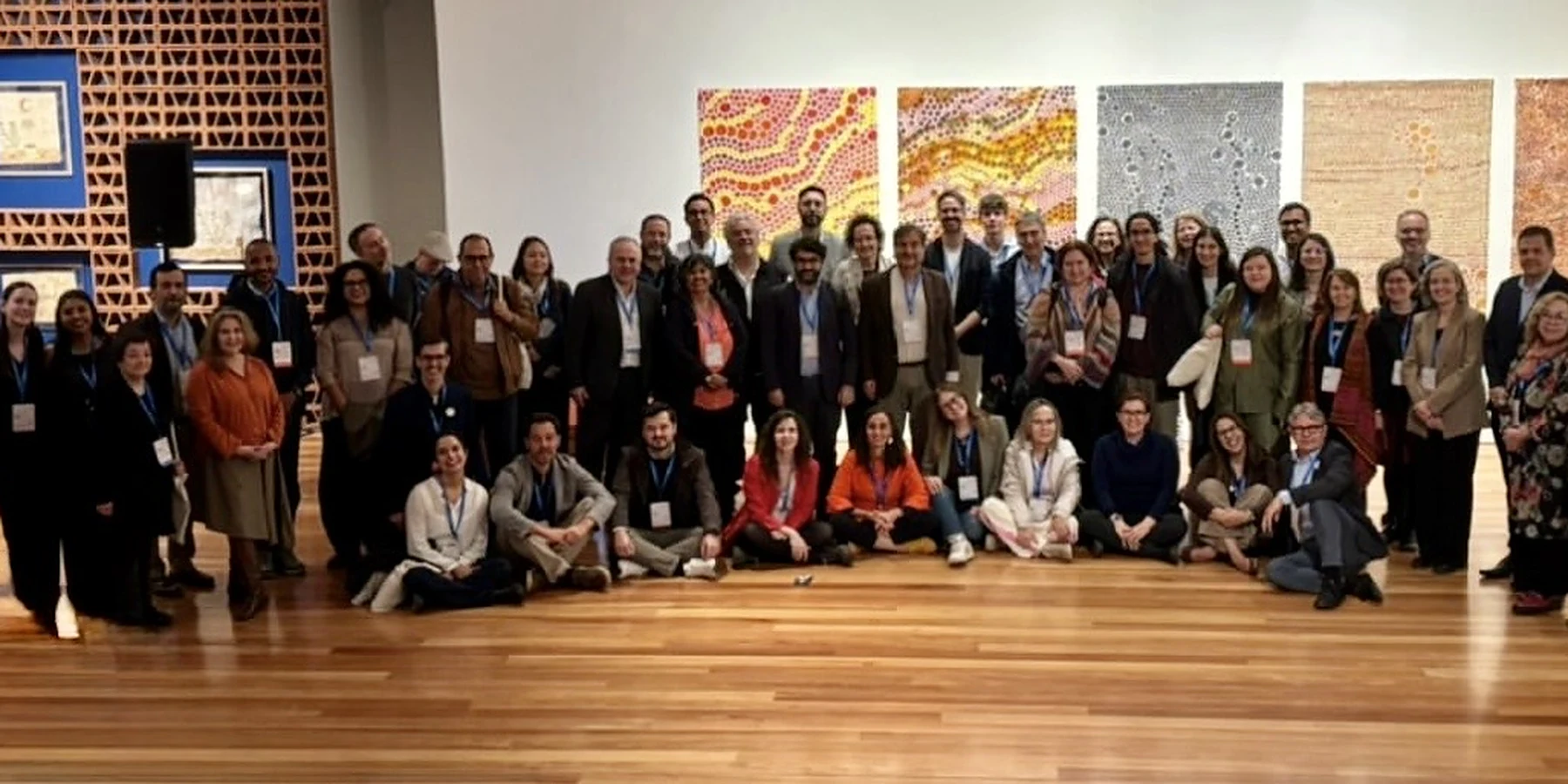
Cover photograph: participants of the VIII International Seminar of RUEF, Santiago de Chile, October 2026.
References
- Baggio, Antonio Maria (ed.) (2006). El principio olvidado: la fraternidad. En la política y el derecho. Buenos Aires: Ciudad Nueva.
- Baggio, Antonio Maria (ed.) (2007). Il principio dimenticato. La fraternità nella riflessione politologica contemporanea. Roma: Città Nuova.
- Barreneche, Osvaldo (2012). “De principio olvidado a principio objetado. Discusiones sobre la fraternidad como categoría política y como perspectiva de estudios académicos”. Revista do Curso de Direito Amicus Curiae 9(9).
- Mardones, Rodrigo (2012). “Fraternity in Politics: New Scholarship and Publications from Latin America”. Claritas: Journal of Dialogue and Culture 1(2).
- Mardones, Rodrigo, and Alejandra Marinovic (2016). “Tracing Fraternity in the Social Sciences and Catholic Social Teaching”. Logos: A Journal of Catholic Thought and Culture 19(2): 53–80.
- Puyol, Ángel (2018). “Sobre el concepto de fraternidad política”. Daimon. Revista Internacional de Filosofía, Suplemento 7: 91–106.
- Puyol, Ángel (2019). Political Fraternity: Democracy beyond Freedom and Equality. London: Routledge.