Notes from ICCGC-WFB 2026, Bangkok
Four days at an interfaith conference in Bangkok: what it means that traditions which will never agree on first principles converge, reliably, at the level of practice.
From 18 to 21 August I was at Srinakharinwirot University in Bangkok for the seventh edition of the Interfaith Coalition Conference for Global Citizens, held this year together with the World Fellowship of Buddhists. I am writing about it because this is the kind of undertaking that rarely makes news and that, I think, deserves to be described more often — not for what it achieves, but for what it is.
Seven years
ICCGC was founded in 2020, in the worst months of the pandemic, as an interfaith action coalition. Its sequence of themes reads like a private chronicle of these years: One World, One Family in 2021; social justice and healing in 2022; One Earth, One Family, One Future in 2023; a consensus declaration with the network of religious NGOs at the United Nations in 2025.
That fact — the continuity — is the least conspicuous thing about the conference and, to my mind, the most valuable. Bringing people of different faiths together once is easy and almost always produces courtesy. Bringing them together every year for seven years produces something else: people who know each other, who remember what the other said last time, who can afford to disagree because they have already spent enough time together not to fear being misread. Trust is not a content that can be transmitted. It is a function of time, and it is the one resource a conference cannot acquire within a conference.
The room
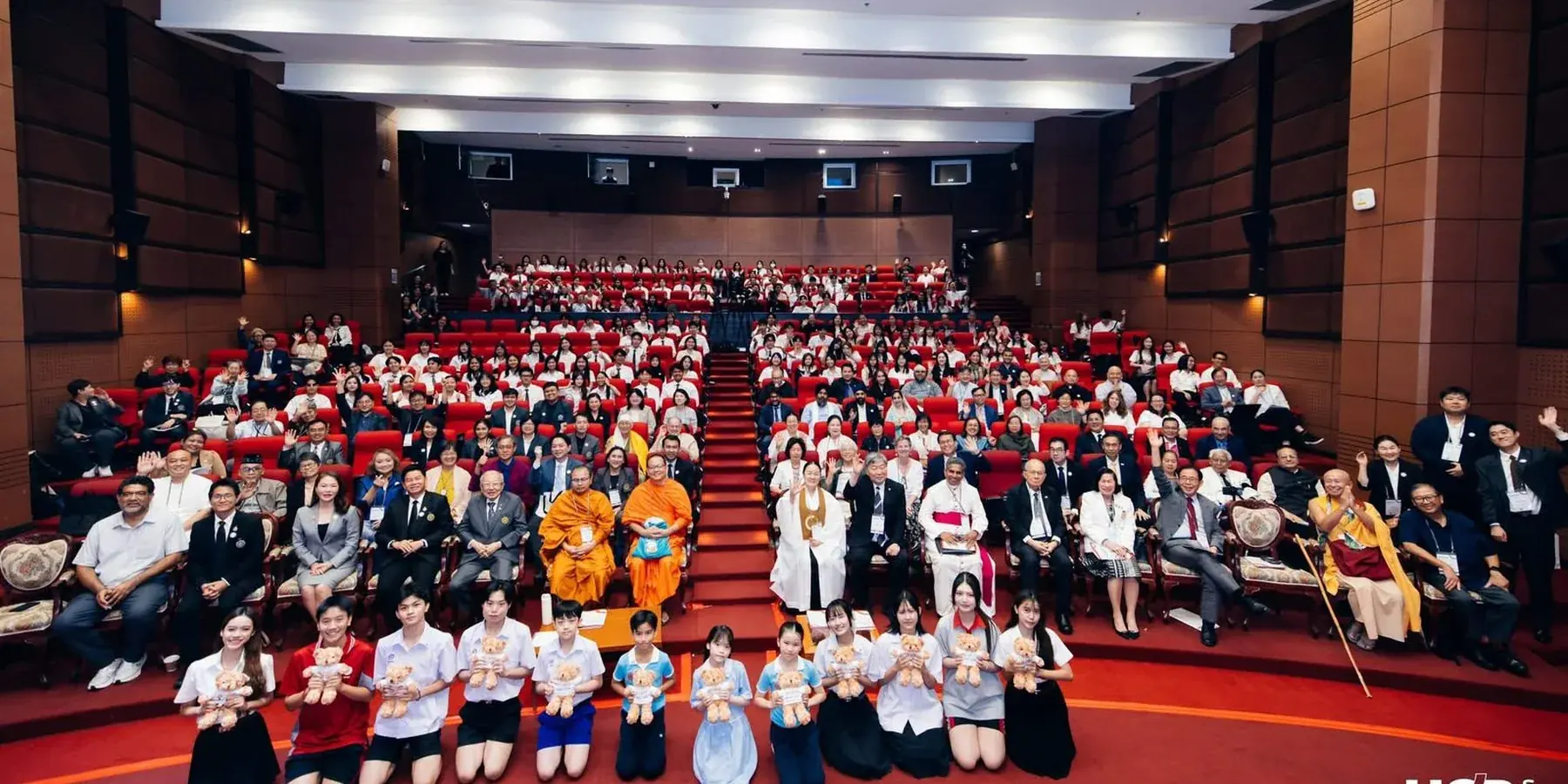
This year’s edition was hosted jointly by Korean Won Buddhism, the World Fellowship of Buddhists and a Thai public university. Which meant that on the same afternoon, in the same room, you had the Secretary of the Vatican Dicastery for Interreligious Dialogue, the abbot of a major Bangkok temple, the city’s Catholic archbishop, a Filipino imam, the Secretary General of Religions for Peace International, Japanese monks, Jesuits, Korean and Thai university presidents, American and European academics.
The opening ceremony included an interfaith prayer for peace in seven voices: Buddhist, Christian, Hindu, Muslim, Jewish, Won-Buddhist, Sikh. Each prays their own, in front of all the others, who listen.
What interfaith dialogue actually does
There is a common and mistaken way of picturing these gatherings: as a search for the lowest common denominator, where each tradition leaves whatever is irreducible about itself at the door and brings in only a generic residue of goodwill. If that were the case it would be a waste of everyone’s time, because nobody spends four days on a residue.
It is not the case. What happens in a room like that is not the discovery of agreement on first principles — an agreement that does not exist, and that none of the participants pretends to be looking for. A Theravāda monk and a Catholic archbishop do not share an ontology, an anthropology, or an account of what salvation is, and the striking thing is that both of them know it perfectly well. What happens instead is convergence at the level of practice: that poverty is intolerable, that violence has to be defused before it detonates, that young people are authors of the present rather than recipients of decisions made elsewhere, that non-human life is not expendable material.
Philosophically this deserves more attention than it gets. That broadly convergent practical conclusions should arise from incompatible metaphysical foundations is either a sign that the conclusions are weaker than we think, or — the more promising reading — that there is an intermediate level, something like the shared experience of vulnerability, which serves as common ground between traditions that will never agree on first principles. The traditions remain themselves. And it is precisely because they remain themselves that their meeting means anything.
The document
The conference closed with the Bangkok Declaration for Planetary Citizenship and Spiritual Civilization: five core commitments across four parts, from ethical and civic foundations to climate responsibility, from the economy to education, with an explicit view beyond 2030.
I would be dishonest if I claimed to expect much from it. The genre is soft law: one affirms, one recognises, one calls upon. It binds as far as the will of the signatories reaches, and signatories, as a rule, already agreed before they signed.
And yet I have changed my mind about what one should ask of a text like this. Its value does not lie in its normative force, which is modest, but in the fact that it could be written at all. Every line is the solid residue of a negotiation among people who each had excellent reasons to concede nothing. The document is not an instrument. It is a trace. It certifies that a conversation took place, and how deep it went. If in two years someone wants to know whether in 2026 Buddhists, Christians, Muslims and Asian public educators could say something non-trivial to one another, that text will answer yes.
The beauty of it
I would rather close on something that has nothing to do with usefulness.
There is a particular beauty to a room like that, and it is not the beauty of harmony. It is the harder kind: differences that do not dissolve. A Thai choir and a Korean quartet singing on the same afternoon; a minute of silence that everyone observes for different reasons; teenagers presenting their projects from the main stage to monks and archbishops who are actually listening; women from five traditions discussing narrative and hope in a parallel session. None of this produces a measurable result. Together they produce a fact: that things can be like this, and that it is worth wanting.
In an age with plenty of reasons to treat religious belonging as a source of division, four days in which it is manifestly the opposite are not a consolation. They are a “counterfactual”, and counterfactuals are the most valuable things we have.